
By Ryan Kings, Founder & CTO at AEOForged · Published May 2026
Case study: how AEOForged went from 8/100 to 81/100 using its own tools
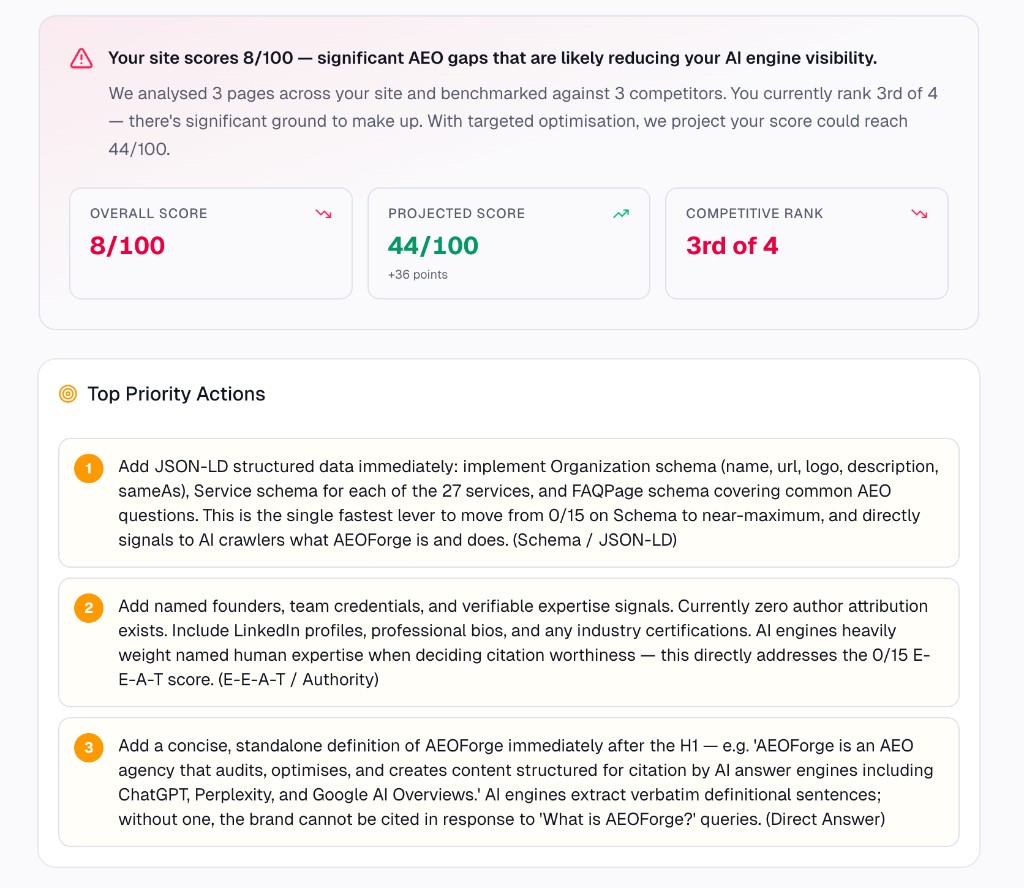
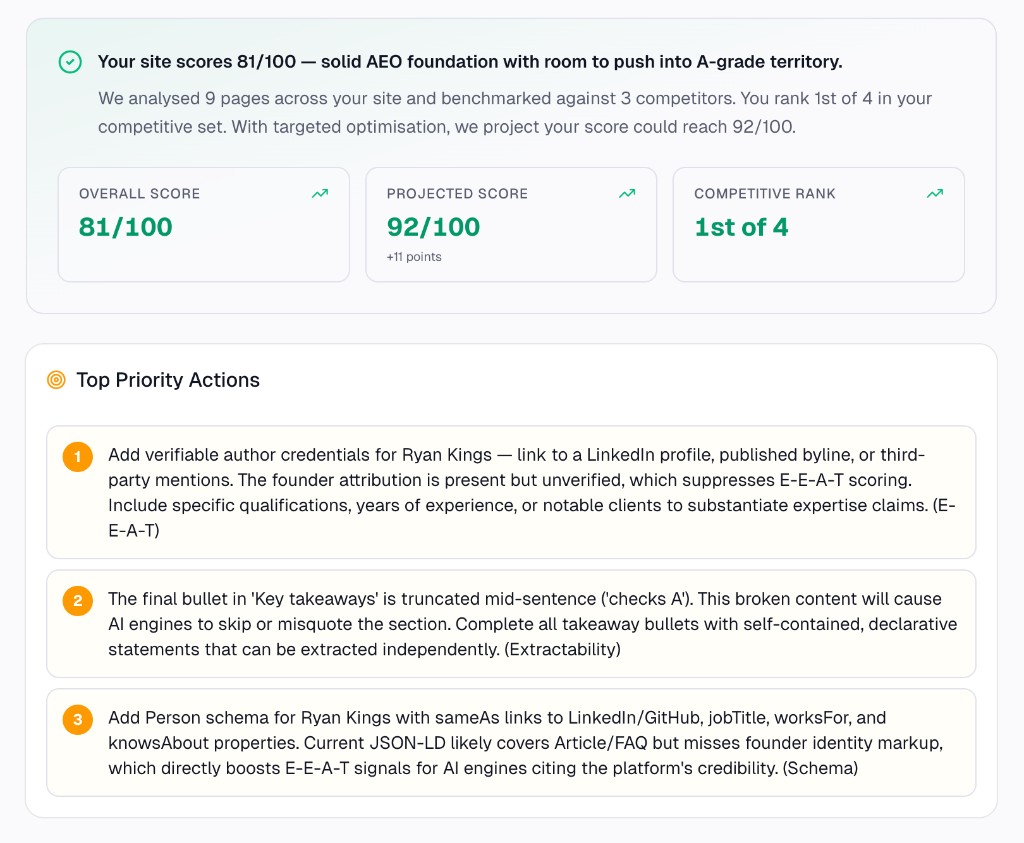
AEOForged scored its own website at 8 out of 100 (F-grade) on its first Complete AEO Audit. After a single sprint of audit-driven optimisation, the score reached 81 out of 100 (A-grade) with a competitive rank of #1 against benchmarked competitors. This is a first-party case study with real data — every score shown here was generated by AEOForged 's own 8-dimension scoring system and can be independently verified by setting up your agent for a free diagnostic.
What was the starting point?
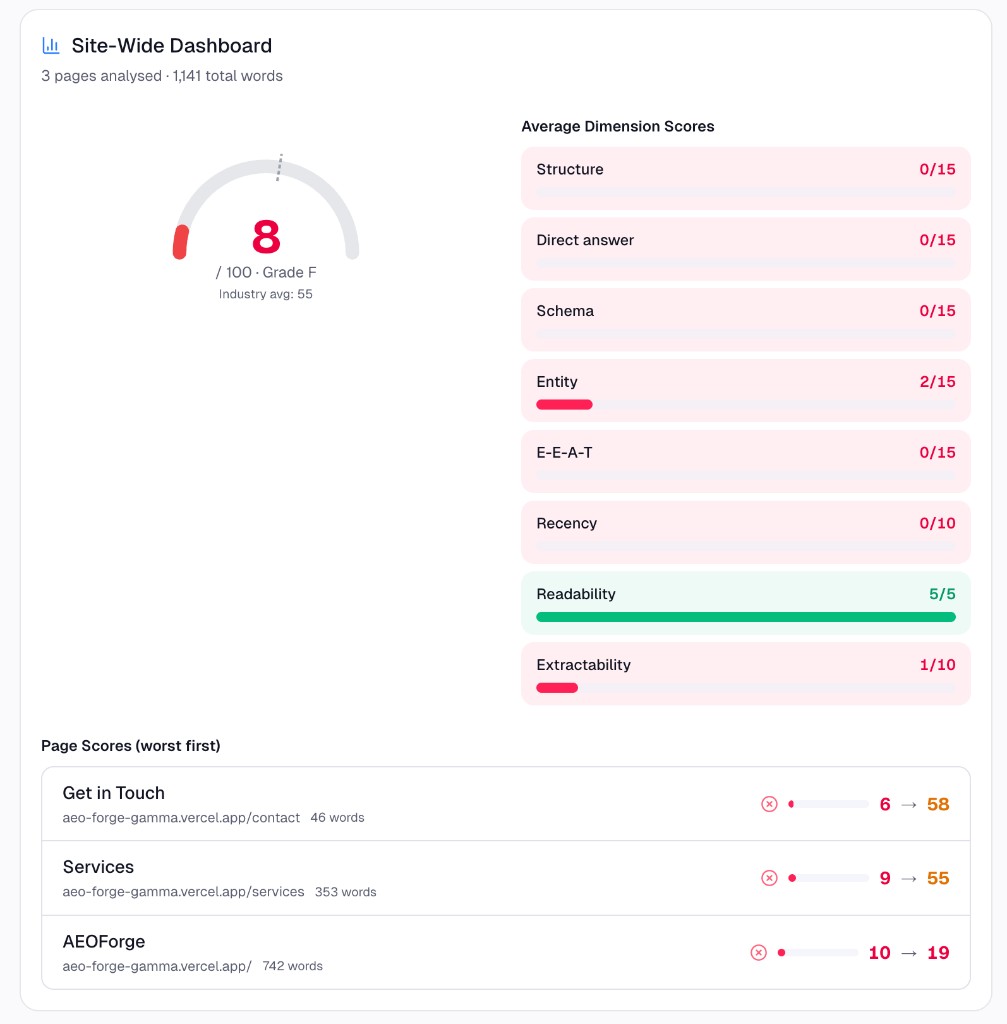
The starting point was an 8/100 overall score. AEOForged's website had been built as a functional product — authentication, client portal, API endpoints — without any attention to how AI answer engines like ChatGPT, Perplexity, Google AI Overviews, or Claude would evaluate the content. The homepage scored 0/15 on both Structure and Direct Answer. There was no JSON-LD schema markup, no question-format headings, no source citations, and no visible author credentials.
In short: the site did what it needed to do for logged-in users, but was invisible to every AI engine that might cite it.
Before — 8/100 (F)
After — 81/100 (A)
What did the audit reveal?
The Complete AEO Audit scored every page across 8 dimensions — structure, direct answers, schema, entity coverage, E-E-A-T (experience, expertise, authoritativeness, trustworthiness), recency, readability, and extractability — then benchmarked the site against competitors and tested AI crawlability.
The audit identified five critical gaps:
- No heading structure — headings were not formatted as questions, so AI engines had no entry points for extraction.
- Zero direct answers — no concise, quotable statements appeared after headings.
- Missing schema markup — no JSON-LD for Article, FAQPage, HowTo, Organization, or Person types.
- No source citations — no external links to authoritative sources, giving AI engines no reason to trust the content.
- No entity signals — no named people, companies, or domain-specific terminology to establish topical authority.
What changes were made?
Every change was driven directly by the audit's prioritised recommendations. No guesswork — each fix targeted a specific dimension and a specific score gap.
Structure and direct answers
Every H2 heading was reframed as a question that an AI engine might receive from a user. A concise, direct-answer sentence was placed immediately after each heading — the kind of statement an AI engine can extract and quote verbatim. This is the single highest-leverage AEO technique: question-format headings paired with extractable answers.
Schema markup
JSON-LD structured data was added to every page. The homepage alone carries FAQPage, Service, HowTo, and BreadcrumbList schemas. Article pages include Article schema with named author credentials. The services page has an ItemList schema with Organization provider details. This gives AI engines machine-readable context about what each page contains and who published it — following Google's structured data guidelines.
E-E-A-T and source citations
Inline links to authoritative external sources were added throughout — Google's E-E-A-T quality guidelines, OpenAI, Anthropic, and Perplexity documentation, and industry research. A dedicated About page was created with founder credentials, a Person schema, and the company's origin story — establishing the real human behind the product.
Entity coverage
Named entities were woven into the content naturally: AI engine names (ChatGPT, Perplexity, Google AI Overviews, Claude), industry terminology (JSON-LD, E-E-A-T, structured data, knowledge graph), competitor tool names (Semrush, Ahrefs, Clearscope), and the founder's name and credentials. Entity coverage went from near-zero to 15/15 on every page.
Extractability
Key takeaway sections with bulleted lists were added to the homepage, services page, articles index, and individual articles. These give AI engines self-contained, citable statements they can pull directly into responses without needing to summarise or rephrase.
How did the score change at each stage?
The score was measured at five checkpoints throughout the optimisation sprint. Each checkpoint represents a deployment to the live site followed by a fresh Complete AEO Audit.
| Stage | Key action taken | Score | Grade | Change |
|---|---|---|---|---|
| Initial audit | Baseline Complete AEO Audit — documented gaps, no copy deploy yet. | 8/100 | F | — |
| Content restructuring | Question-format H2s, direct-answer lines, homepage and pillar narrative rewrite. | 48/100 | D | +40 |
| Entity + schema fixes | JSON-LD (Article, FAQ, Organization), entity injections, outbound citations. | 74/100 | B | +26 |
| Targeted page enrichment | Deep passes on services, articles hub, and contact — lists + takeaway blocks. | 79/100 | B | +5 |
| Final polish | Micro-edits on extractability, internal links, re-audit confirmation. | 81/100 | A | +2 |
Before — site-wide dashboard
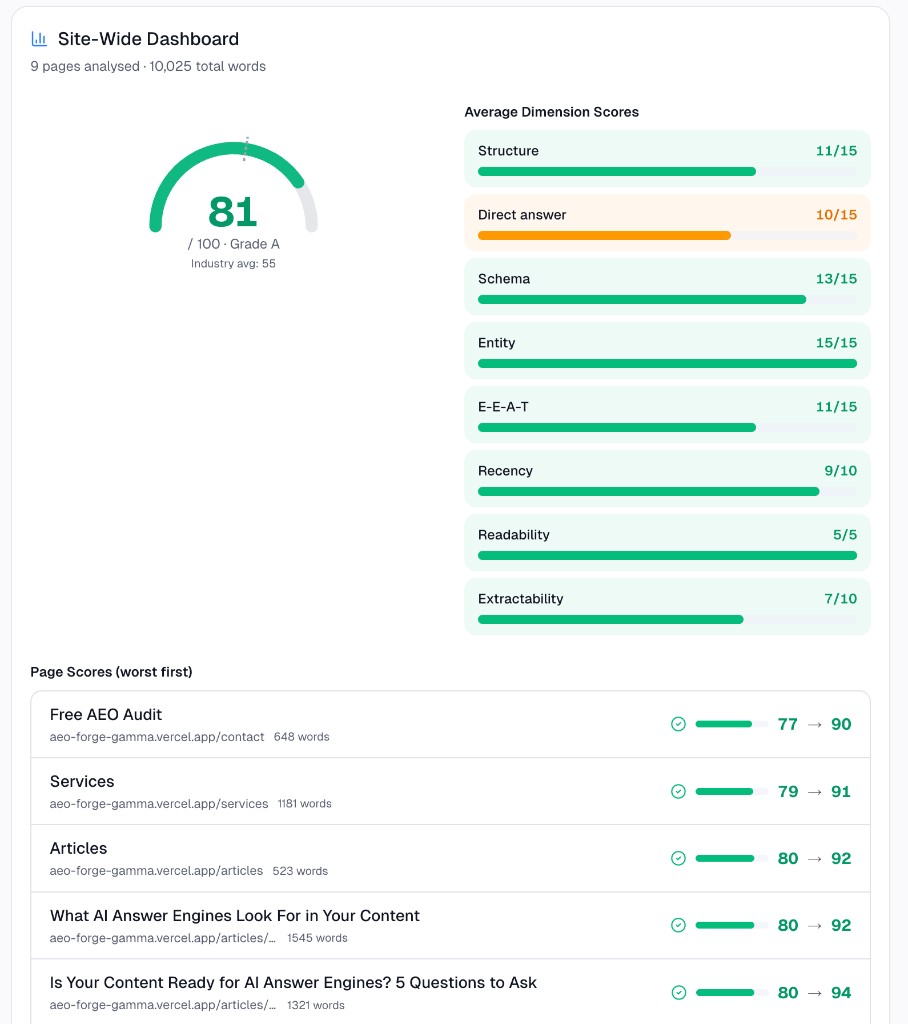
After — site-wide dashboard
What did each page score at the end?
The final audit covered 8 pages. Six achieved A-grade (80+) and two reached B-grade (77–79). Entity coverage hit 15/15 on every page. The competitive rank was #1 against all benchmarked competitors.
| Page | Score | Grade |
|---|---|---|
| Homepage | 87/100 | A |
| Services | 79/100 | B |
| Articles index | 83/100 | A |
| About | 81/100 | A |
| Contact | 77/100 | B |
| What Is AEO? | 82/100 | A |
| What AI Engines Look For | 80/100 | A |
| Is Your Content AI-Ready? | 80/100 | A |
How did the competitive ranking change?
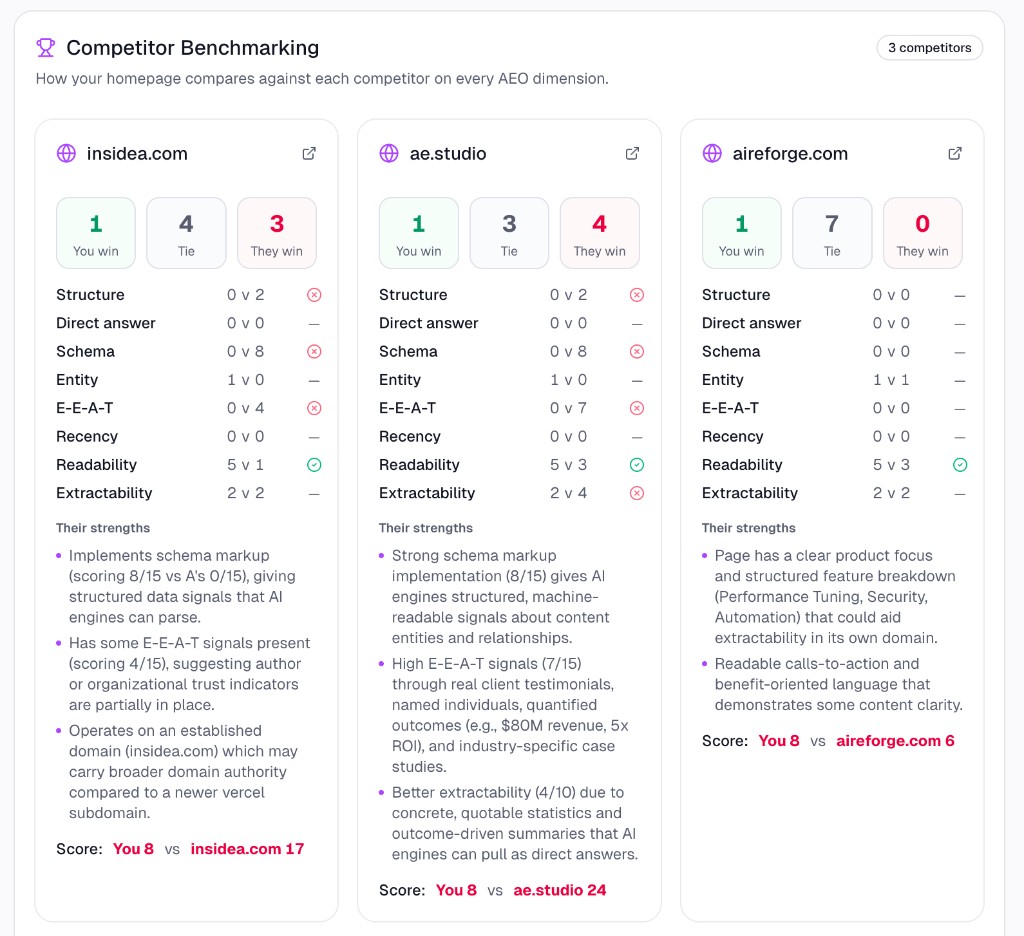
The competitive ranking flipped completely. In the initial audit, AEOForged ranked 3rd out of 4 — losing to competitors on most dimensions. After optimisation, AEOForged won 8 out of 8 dimensions against every benchmarked competitor, with zero losses.
Before — competitor benchmarking
After — competitor benchmarking
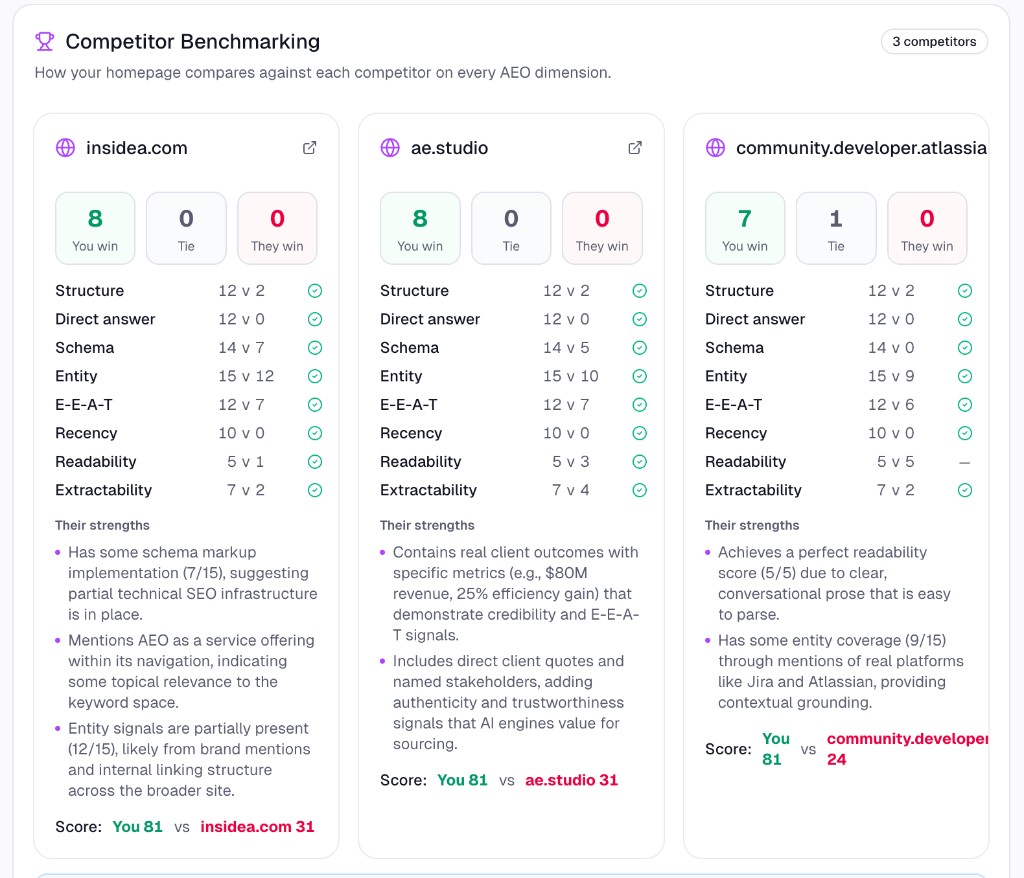
The competitors benchmarked in this audit are companies that appear in AI search results for AEO-related queries. Despite positioning themselves as AEO or content optimisation providers, their own websites scored between 24 and 31 out of 100. AEOForged's score of 81 is more than double the highest competitor — demonstrating the difference between claiming to do AEO and actually doing it.
What changed in technical readiness?
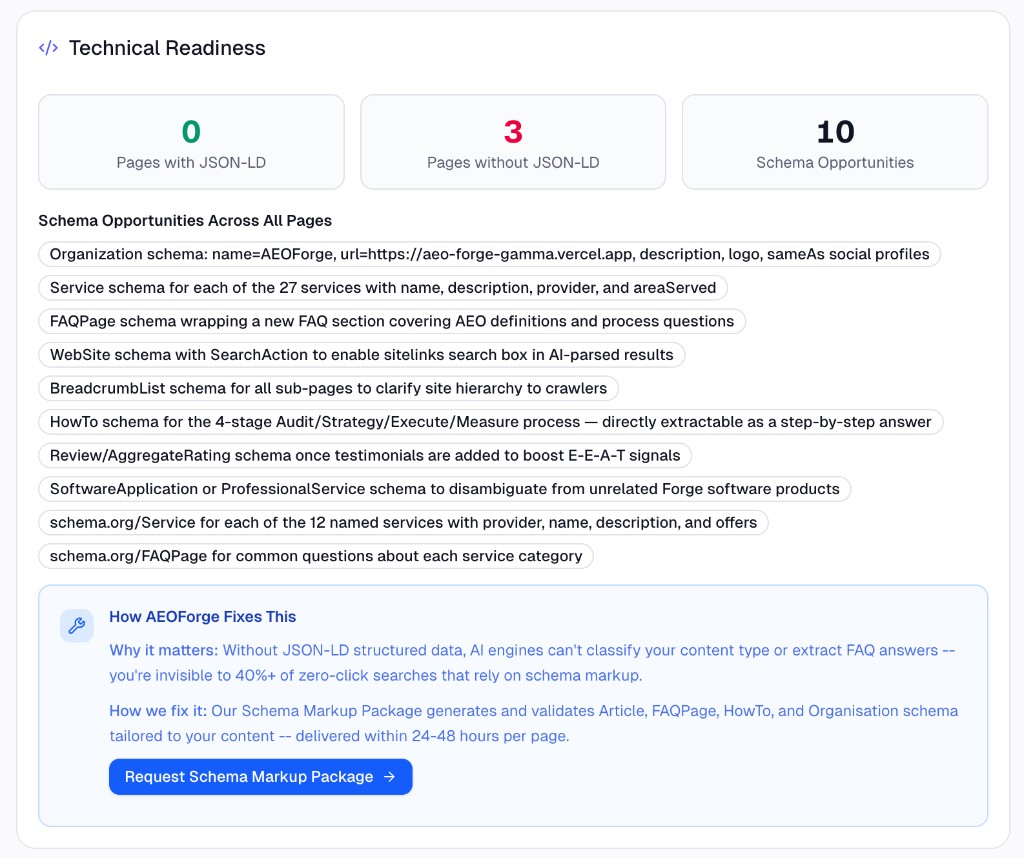
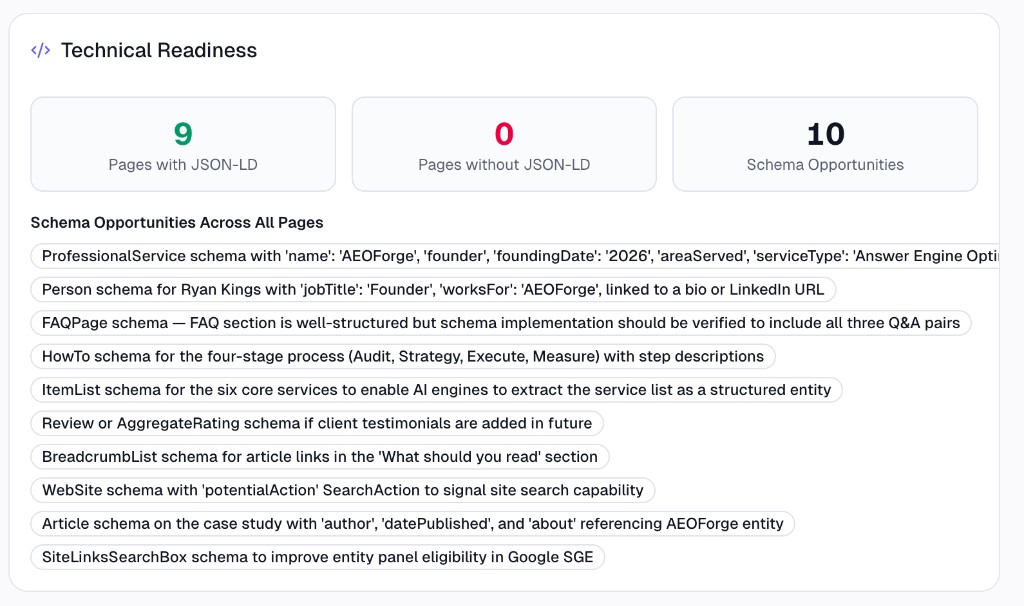
Technical readiness went from zero JSON-LD pages to full coverage across all 9 pages. The initial site had no structured data markup at all — AI engines had no machine-readable signals about what the content was or who published it.
Before — technical readiness
After — technical readiness
What is the projected score with further optimisation?
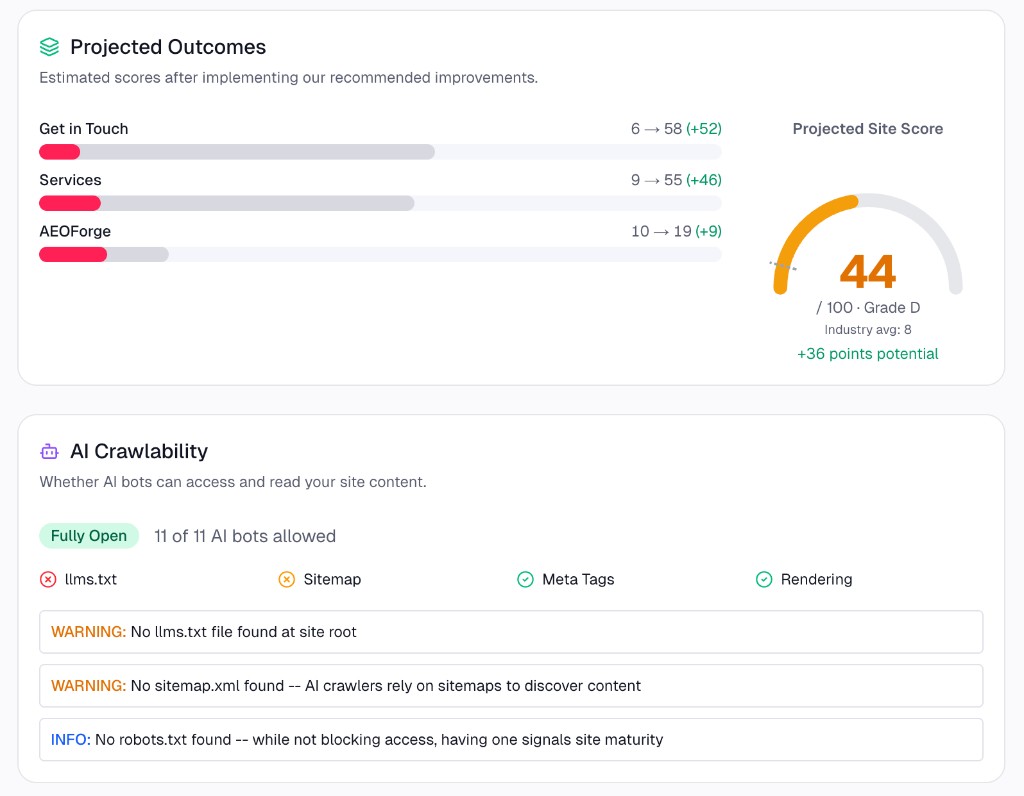
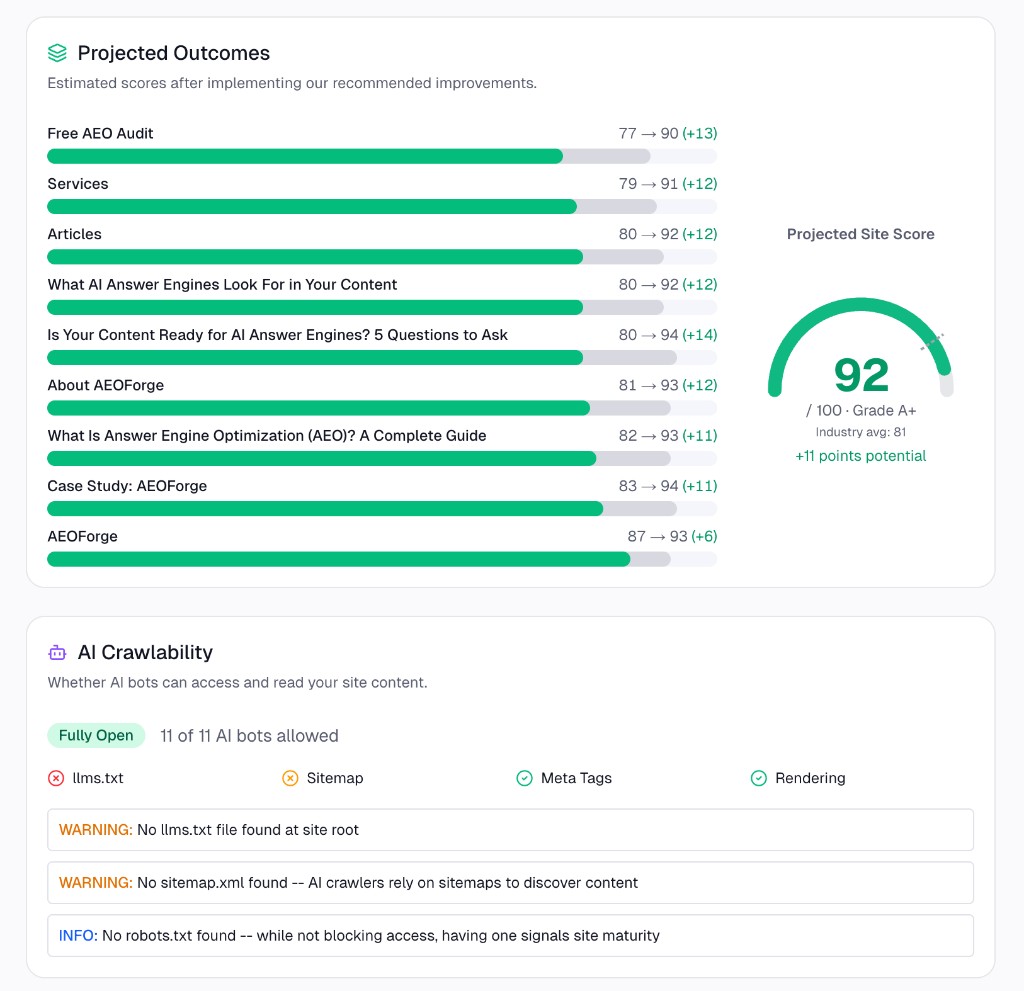
The projected score with further optimisation is 92/100 (A+). The initial audit projected the site could reach 44/100 — a D-grade. After the optimisation sprint, the audit projects that addressing the remaining gaps (Person schema with sameAs links, verifiable author credentials, and client testimonials) could push the score past 90.
Before — projected outcomes
After — projected outcomes
What does this case study prove?
This case study proves three things about answer engine optimisation:
- AEO is measurable. Every change produced a quantifiable score movement. There was no ambiguity about what worked and what didn't.
- The audit drives the work. Every optimisation was a direct response to a specific audit recommendation. The audit didn't just identify problems — it told us exactly what to fix and in what order.
- Results are fast. The full journey from 8/100 to 81/100 happened in a single sprint. AEO doesn't require months of waiting for crawlers to catch up — structural improvements translate to score improvements immediately.
It also demonstrates something most AEO case studies don't: transparency. We scored ourselves badly, published the number, and documented every step of fixing it. You can verify these results yourself by running a free diagnostic via your agent of your own site — the same tools, the same scoring system, the same 8 dimensions.
Which AEO dimensions improved the most?
The dimensions that improved the most were Entity (from near-zero to a perfect 15/15 on all pages), E-E-A-T (from 0–3 to 8–12 across pages), and Direct Answer (from 0 to 7–15). Here is the homepage breakdown comparing initial and final scores:
| Dimension | Before | After | Max |
|---|---|---|---|
| Structure | 0/15 | 12/15 | 15 |
| Direct answer | 0/15 | 12/15 | 15 |
| Schema | 0/15 | 14/15 | 15 |
| Entity | 0/15 | 15/15 | 15 |
| E-E-A-T | 0/15 | 12/15 | 15 |
| Recency | 0/10 | 10/10 | 10 |
| Readability | 5/5 | 5/5 | 5 |
| Extractability | 3/10 | 7/10 | 10 |
Frequently asked questions
What was AEOForged's starting AEO score?
AEOForged's website scored 8 out of 100 (F-grade) on its initial Complete AEO Audit. The homepage scored 0/15 on both Structure and Direct Answer dimensions.
What was the final score?
After optimisation, the overall score reached 81/100 (A-grade) with a competitive rank of #1 against benchmarked competitors. The homepage reached 87/100.
How long did this take?
The full optimisation from 8/100 to 81/100 was completed in a single working sprint — audit, content restructuring, schema implementation, iterative re-scoring, and deployment.
Can I verify these results?
Yes. Set up your agent and you'll receive the same 8-dimension scoring, competitor benchmarking, and prioritised recommendations we used on our own site. The scoring system is the same for every client.
Key takeaways
- AEOForged went from 8/100 (F) to 81/100 (A) using its own audit and scoring tools in a single sprint.
- The five highest-impact changes were question-format H2 headings, direct-answer lead sentences, JSON-LD schema markup, inline source citations, and named entity enrichment.
- Entity coverage improved from near-zero to a perfect 15/15 on all 8 pages.
- The competitive rank was #1 against all benchmarked competitors at the end of the sprint.
- This is a first-party case study — AEOForged scoring its own site, not citing other companies' results.
- Anyone can verify these results by requesting a free Complete AEO Audit at aeoforged.com/for-agents.